- Products & Services
- CONFLEX DOCK New Features
New Features in CONFLEX DOCK 1 Rev.B
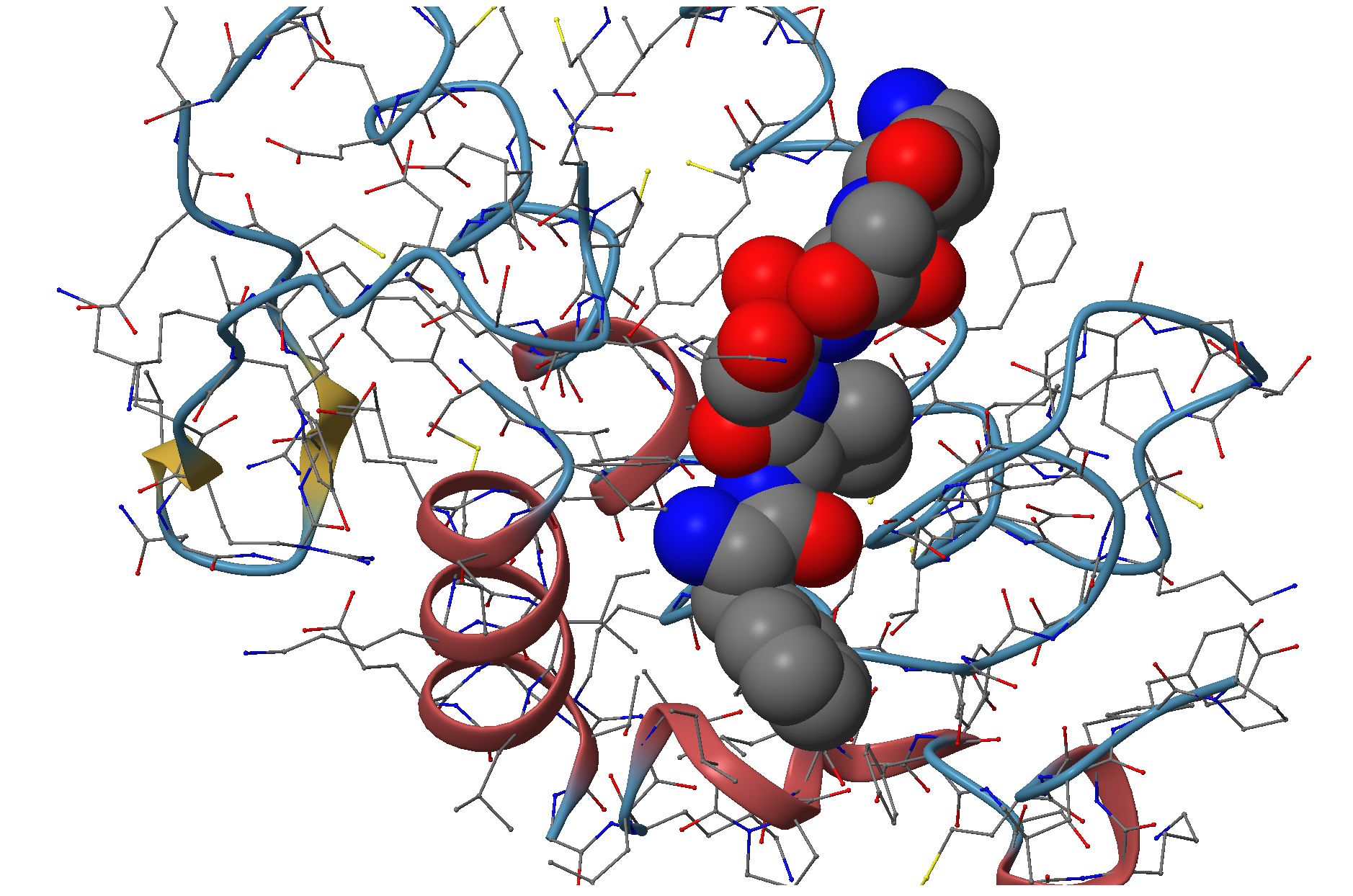
- Generation of Three-Dimensional Protein-Peptide Complex Structures
When a three-dimensional peptide structure is supplied as input, CONFLEX DOCK can now superimpose it onto a docking pose found during the search and output the resulting protein-peptide complex structure. The output can be used directly as input for molecular calculations. - System Requirements
Windows (64bit): 11
macOS: 15, 26
Linux CONFLEX: RedHat EL 8.6, 8.8, 8.10, 9.2, 9.4, 9.6
Ubuntu 22.04, 24.04
(Please contact us for support on other Linux distributions)
CONFLEX DOCK 1 Rev.A
- Peptide Binding and Complex Prediction
Predicts where a specified peptide chain binds to a target protein to form a complex. - Coarse-Grained Structures and Tetrahedron Construction
Protein amino acid residues are represented by their Cα atoms, and tetrahedra are constructed using Delaunay triangulation. - Generation of Surface Search Points
Search points are placed on the protein surface using a surface area calculation method employed to evaluate solvent effects. These points are used to determine docking poses. - Affinity Evaluation Using a Four-Body Potential
Peptide residues are placed at the search points, and affinity is evaluated using a coarse-grained four-body potential derived from experimental structure databases as the scoring function. - Fast, Comprehensive Searches
A coarse-grained potential simplifies scoring, enabling fast, comprehensive searches even for large proteins. - Prediction from Peptide Sequence Data
Calculations can be performed using only the three-dimensional structure of the protein and the peptide sequence. - Comparison with Known Structures
When a peptide's three-dimensional structure is known, its coordinates can be supplied to calculate and compare deviations from the search points.